> For the complete documentation index, see [llms.txt](https://docs.hashsphere.com/llms.txt). Markdown versions of documentation pages are available by appending `.md` to page URLs; this page is available as [Markdown](https://docs.hashsphere.com/development/application-deployment.md).
# Application Deployment
This page covers how the managed platform is deployed and how you deploy your applications. It also clarifies the boundary between HashSphere responsibilities and customer responsibilities.
### HashSphere platform deployment (managed)
Deployment and operation of HashSphere instances is performed by the HashSphere team. For the platform component breakdown, see [Architecture Overview](/managed-service/architecture-overview.md).
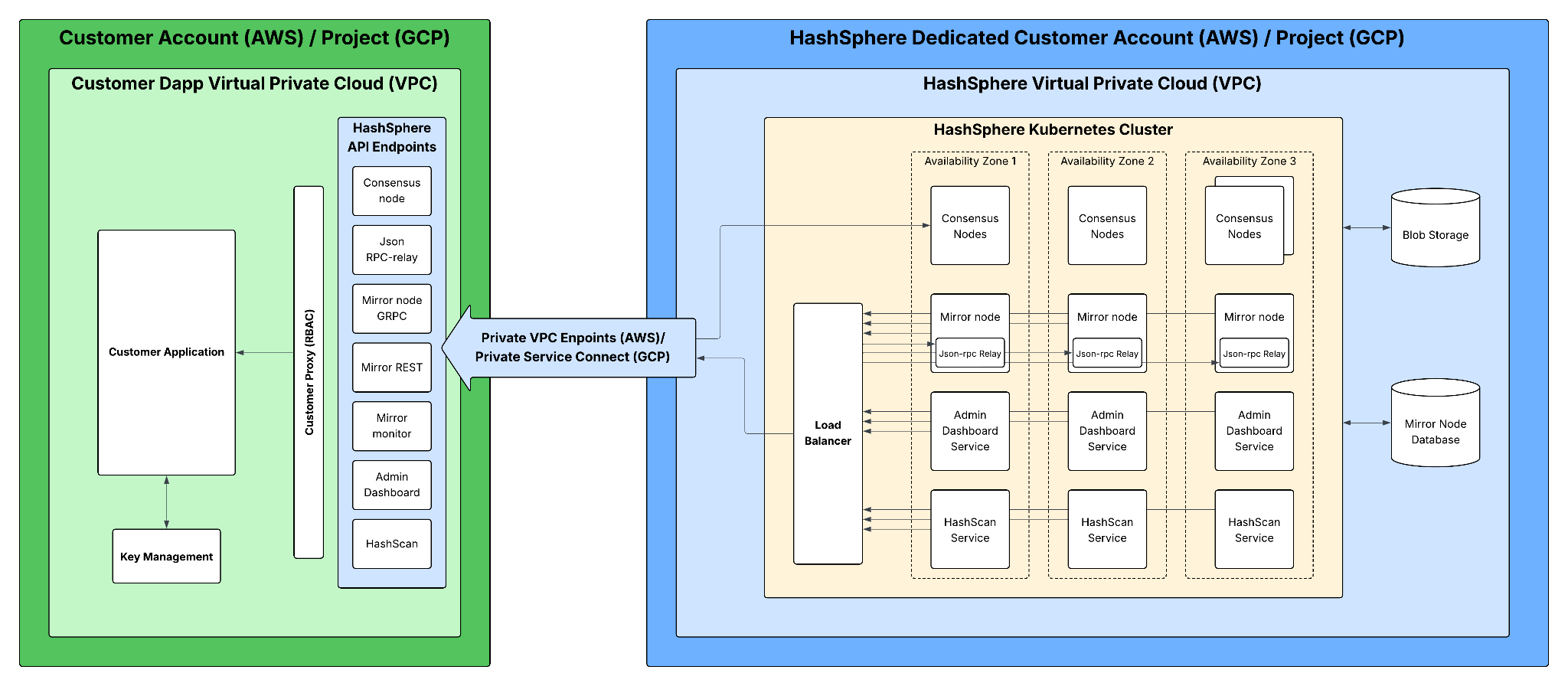
HashSphere endpoints are private. They are exposed into the customer VPC using:
* AWS VPC endpoints (PrivateLink patterns)
* GCP Private Service Connect
There is no public internet access to HashSphere endpoints.
This can be depicted as follows:
HashSphere endpoints do not enforce application-level authorization by default. They assume any workload in the customer VPC can reach them.
If you need fine-grained control, place a customer-managed proxy or API gateway in front of the endpoints.
To maintain segregation of duties, customers do not have access to internal HashSphere platform operations. Customers use the [HashSphere Console](/operations/hashsphere-console.md) for platform health visibility.
During onboarding, the HashSphere team can bootstrap initial accounts. Control of customer-owned accounts is passed to the customer.
### Customer application deployment
Use a standard CI/CD pipeline for application deployment. Treat HashSphere like any other production dependency.
#### Off-ledger components
Deploy your off-ledger services in your own VPC. These services call HashSphere via the private endpoints.
Customer operations teams deploy and operate customer services. The HashSphere team does not deploy customer components.
#### On-ledger components
Customers deploy and manage on-ledger components, for example:
* Administration and user account set up and funding
* HTS Token definition and deployment
* HCS topic configuration
* Smart contract deployment and management
* HFS configuration
For account bootstrap guidance, see [Creating Initial Accounts](/development/creating-initial-accounts.md).
---
# Agent Instructions
This documentation is published with GitBook. GitBook is the documentation platform designed so that both humans and AI agents can read, navigate, and reason over technical content effectively. Learn more at gitbook.com.
## Querying This Documentation
If you need additional information that is not directly available in this page, you can query the documentation by asking a question.
Perform an HTTP GET request on the following URL with the `ask` and `goal` query parameters:
```
GET https://docs.hashsphere.com/development/application-deployment.md?ask=&goal=
```
`ask` is the immediate question: it should be specific, self-contained, and written in natural language.
`goal` is what the user is ultimately trying to achieve, the reason they need the answer. Sharing it helps GitBook give you a better, more relevant answer. A goal is most helpful when it describes the outcome the user wants rather than restating the question. For example, with `ask=how do I create an API token`, a goal like `automate deployments from our CI pipeline` lets GitBook tailor the answer to that use case.
The response will contain a direct answer to the question and relevant excerpts and sources from the documentation.
Use this mechanism when the answer is not explicitly present in the current page, you need clarification or additional context, or you want to retrieve related documentation sections.